
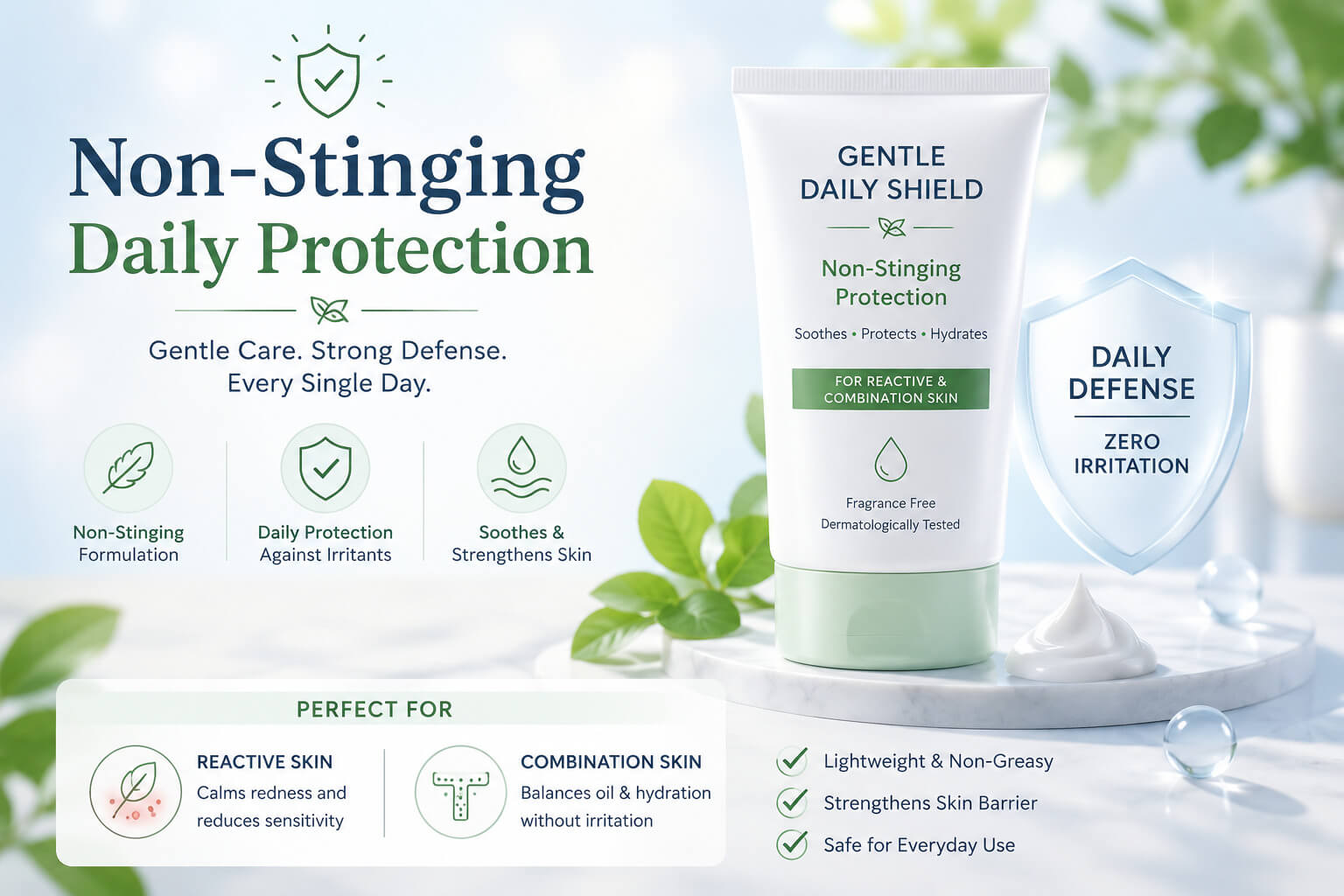
Some sunscreens reveal their problems immediately, where a sharp feeling appears beside the nose, a dry patch becomes more obvious, or the eye area starts to feel uncomfortable.
In other cases, everything looks fine in the bathroom mirror until you find your forehead shiny and your cheeks tight by midday. That is the difficulty with combination skin that is also reactive.
Oiliness doesn’t mean your whole face needs a drier routine, just as sensitivity cannot always be traced to a single ingredient. Choosing a mineral sunscreen for sensitive skin means accounting for those uneven conditions and considering the full formula, not just the claims printed on the bottle.
Why Can SPF Sting Combination-Reactive Skin?
Combination skin often receives mixed treatment. The T-zone is cleansed thoroughly because it becomes oily, and pores are exfoliated a little more often. Moisturizer is used sparingly, sometimes only on the cheeks.
Each decision seems reasonable on its own, but put together, certain parts of the face may be left with very little comfort before sunscreen is even applied.
This explains why SPF can seem fine one day and unpleasant another day; the formula may not have changed, but the skin underneath it has. A strong exfoliating evening, cold weather, several new serums, or simply too much rubbing can alter what the skin tolerates.
This is why clean clinical skincare accounts for the condition of the barrier, rather than treating every sign of discomfort as a reason to avoid daily SPF.
The narrow folds around the nostrils are usually revealing. These areas are easy to over-clean and difficult to moisturize evenly. As sunscreen reaches them last, it gets blamed for a reaction that may have been building for days.
Even a non-irritating SPF cannot promise comfort on skin that has recently been overworked. “Non-irritating” also describes a formulation goal, not an assurance that every user will respond the same way. So, if stinging continues, or returns with several unrelated products, advice from a qualified skin professional is more useful than another product swap.
A Mineral Filter Does Not Tell the Whole Story
Zinc oxide and titanium dioxide are recognized mineral sunscreen actives. The US Food and Drug Administration lists both in its over-the-counter sunscreen monograph, which also covers permitted concentrations, SPF testing, broad-spectrum testing, and labeling conditions. Still, the filter name says little about how the finished sunscreen will behave at, say, 3 p.m. Zinc oxide has to sit within a complete formula.
Oils, silicones, emollients, powders, humectants, and film-forming ingredients all influence how that formula moves across the face and what remains once it settles. At the same time, while one zinc-based sunscreen may feel creamy and flexible, another may dry quickly and catch on a rough patch near the chin. Neither experience can be predicted from the words “mineral sunscreen” alone.
For that reason, consider a mineral sunscreen for sensitive skin as a full formula. Also ask these questions to reveal more than broad claims about suitability for skin types:
- Can it be spread without going back over the same spot repeatedly?
- Does it stay comfortable on the outer cheeks?
- Does it become heavy where oil usually appears?
The Barrier May Need Attention First
A new formula is opened, worn twice, and pushed aside. Then the search begins again, and after several unsuccessful attempts, SPF appears to be the common problem.
For a few days, it may help to remove whatever is not essential. That might mean pausing an extra exfoliating toner, putting aside a recently introduced active, and using a cleanser that does not leave the face feeling squeaky.
Moisturizer need not be applied in exactly the same amount everywhere. Barrier lipids matter during this reset: lipids occur naturally within the outer skin structure and help reduce moisture loss.
When that structure is under strain, the face feels tight after cleansing and unexpectedly reactive during application. Sunscreen is then being applied on a surface that has not fully recovered.
As such, a stripped-back routine is often the better choice while the barrier settles. A mild cleanser, a moisturizer with barrier-supporting lipids, and daily SPF may be enough for the moment.
Adding several serums that promise similar benefits can make it harder to identify what the skin actually tolerates.
All in all, give each step a clear purpose, then allow the routine enough time to show whether the discomfort is easing.
Testing a Combination Skin SPF Properly
For a combination skin SPF, the formula must move across dry areas without clinging to them. Yet it cannot feel excessively rich through the middle of the face, and may also need to sit beneath concealer, foundation, or powder.
A quick test on the back of the hand will not answer those questions. Neither will the first five minutes after facial application.
Instead, try the sunscreen over the same basic morning routine on several separate days. Look again after lunch, and pay attention to the sides of the nose, the hairline, the groove below the lower lip, and the point where the jaw meets the neck.
Keep the test uncomplicated:
- Avoid introducing a new serum or moisturizer on the same morning
- Give moisturizer time to settle before applying sunscreen
- Spread sunscreen carefully instead of repeatedly rubbing one area
- Use the quantity and reapplication method stated on the label
- Stop if discomfort continues or worsens
This approach may sound slow, but it produces cleaner information. Otherwise, several changing products are being judged at once, and the sunscreen may be rejected for something caused by something else.
Mineral Protection That Does Not Ignore Texture
For daily wear, look for a mineral formula that spreads readily and settles without making dry areas feel tighter. Zinc oxide provides mineral UV protection, but the surrounding formula still affects comfort, finish, and wear. A sunscreen that sits well beneath makeup and does not require repeated rubbing is more likely to be applied evenly.
These details have practical value for anyone choosing a reactive skin sunscreen. A difficult texture encourages dragging and repeated blending. A formula that remains conspicuous may also lead to a thinner application than the label recommends.
Sun protection works best within a wider barrier-conscious routine. That perspective is important because sunscreen is only one part of what the skin experiences each morning. Cleansing, exfoliation, moisturizing, weather, and recently introduced actives can all influence how comfortable the final layer feels.
A carefully chosen mineral sunscreen for sensitive skin still needs skin that is being cleansed, moisturized, and treated with some restraint. Applying it over an overloaded routine may recreate the same discomfort that started the search.